
For years, search engine optimization (SEO) has revolved around a single dominant player: Google.
Brands have invested heavily in keyword research, link building, structured data, and Core Web Vitals all in pursuit of better visibility in traditional search results.
That landscape is now changing.
OpenAI has accelerated this shift with a series of major releases:
- Structured product feeds for merchants – OpenAI now allows businesses to submit product catalogs directly to ChatGPT in a standardized format.
- In-chat purchasing – With “Buy it in ChatGPT: Instant Checkout and the Agentic Commerce Protocol,” users can complete purchases without leaving the conversation.
- Shopping research inside ChatGPT – Just two months later, OpenAI introduced native shopping research, enabling deeper product discovery within chat.
What This Means for eCommerce Brands
Your product catalog can now surface directly inside ChatGPT conversations complete with accurate pricing, real-time availability, and richer contextual recommendations than traditional search listings.
Think of it as Google Shopping feeds, reimagined for AI-driven search and conversational commerce.
Why ChatGPT Matters for eCommerce Right Now
The way consumers discover products online is shifting.
For years, brands optimized for Google Shopping, Meta Ads, and Amazon’s algorithms. Now, with over 700 million weekly active users, ChatGPT has rapidly emerged as a powerful new channel for product discovery and purchasing decisions.
When a user asks, “What are the best running shoes under $150 for trail hiking?” they’re no longer met with a grid of ads or a marketplace ranking. Instead, they receive curated, contextual recommendations driven by intent, conversation, and real product data.
And that changes everything.
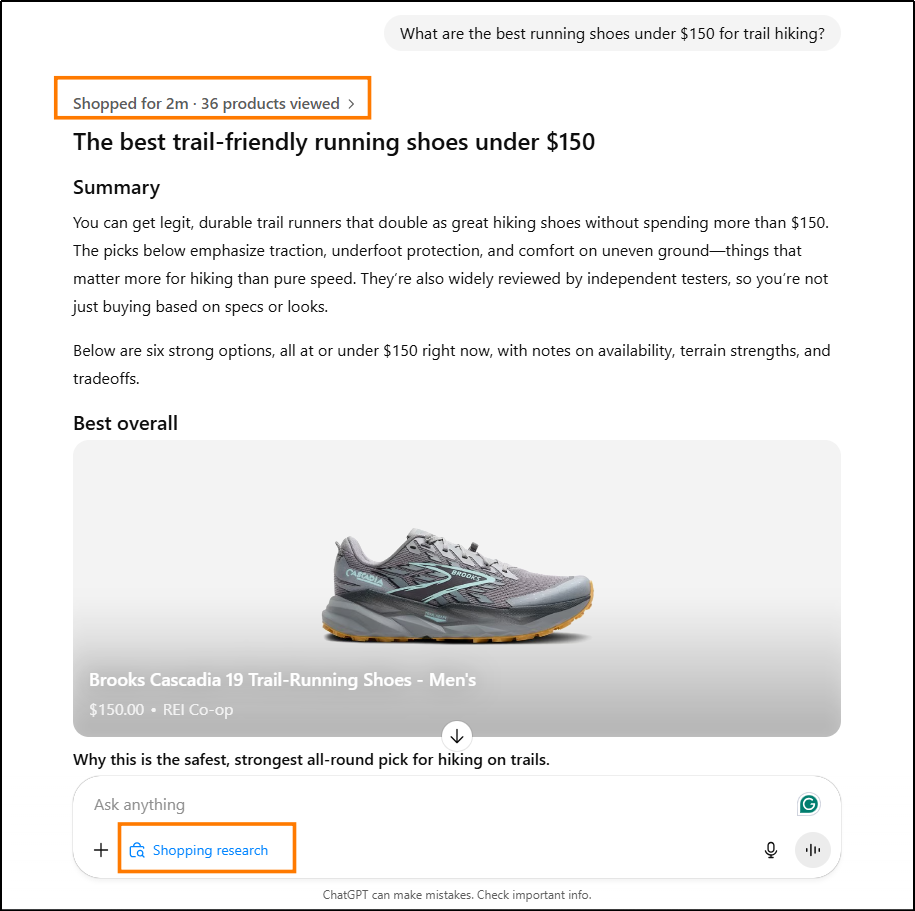
Instead of showing ads or endless product grids, ChatGPT delivers a curated set of up to 36 highly relevant product recommendations, tailored to each user’s needs, budget, and context.
OpenAI’s new Shopping Research experience takes this a step further. When a user submits a shopping-related query, ChatGPT automatically generates a comprehensive buying guide comparing top options, highlighting key differences, and explaining what matters most before making a purchase.
For eCommerce brands, this shift presents both a major opportunity and a new challenge. ChatGPT’s influence on purchasing decisions isn’t a future possibility it’s already happening. And with OpenAI enabling merchants to submit and refresh product feeds every 15 minutes, the platform is rapidly evolving into a real-time commerce ecosystem.
This guide will walk you through everything you need to know about getting your products discovered on ChatGPT. You’ll learn how to submit your product feed, which data fields matter most, and how to optimize titles, descriptions, variants, and trust signals so ChatGPT can surface your products more effectively in recommendations.
The Growing Impact of ChatGPT on E-commerce
ChatGPT now processes over 2 billion queries per day and attracts 5.8 billion visits per month, making it one of the most active digital touchpoints on the internet.
What does this mean for eCommerce brands?
A significant portion of these interactions are tied directly to shopping, product research, and purchase decisions. This is no longer an experimental behavior shopping has become a core use case for millions of ChatGPT users.
According to Adobe Analytics, nearly 38% of generative AI shoppers already use AI tools to discover gift ideas, firmly embedding ChatGPT into the shopping journey.
Early on, many merchants questioned whether ChatGPT could convert as effectively as traditional channels. Initial data suggested lower conversion until OpenAI introduced Instant Checkout. With this capability, shoppers can now complete the entire transaction directly within the chat experience.
A complete buying journey, all in one interface.
This convergence marks a pivotal moment for both brands and consumers. High-intent queries, personalized recommendations, and instant purchasing are now fully integrated inside ChatGPT. It’s a new frontier for eCommerce and brands that move early will gain a lasting competitive advantage.
How ChatGPT Shopping Works: Three Key Layers
To understand ChatGPT’s shopping ecosystem, it’s important to recognize three distinct yet interconnected components.
3.1 Organic Product Discovery (No Registration Required)
When users ask ChatGPT for shopping recommendations, the platform analyzes publicly available retail content and surfaces products based on relevance, quality, and contextual alignment.
This discovery layer is entirely organic.
No ads.
lass=”yoast-text-mark” />>No sponsorships.
lass=”yoast-text-mark” />>No paid product placements.
For merchants, getting discovered at this layer is surprisingly straightforward. There’s no application process or special program to join you simply need to ensure your product pages are technically sound and semantically optimized.
Here’s what matters most:
- Allow access for OAI-SearchBot
Your robots.txt file must permit OAI-SearchBot to crawl your product pages. If it’s blocked, ChatGPT can’t access or surface your catalog.
- Strong eCommerce SEO fundamentals
Implement clean, complete schema.org/Product markup so ChatGPT can accurately extract key attributes such as price, availability, brand, ratings, variants, and more.
- Conversational product descriptions
Write product copy that answers real customer questions instead of relying solely on dry specifications or bullet points. ChatGPT performs best with content that reflects natural language and user intent.
- Accurate pricing and inventory data
Products with missing, inconsistent, or outdated information are unlikely to be recommended. Keeping your catalog up to date is essential.
Any publicly accessible online store can appear in ChatGPT’s organic shopping recommendations. If your product pages are crawlable, well-structured, and rich in context, you’re already ahead of competitors who overlook these fundamentals.
3.2 Instant Checkout (Transactional Layer)
Instant Checkout introduces a new way for customers to purchase products directly within ChatGPT. Powered by the Agentic Commerce Protocol (ACP) and supported by Stripe, it enables a fast, secure, and frictionless checkout experience.
How it works
When a user requests product recommendations, eligible items display a simple “Buy” button. With a single click, the purchase is completed through the merchant’s existing payment infrastructure no redirects, no extra steps, and no break in the conversation.
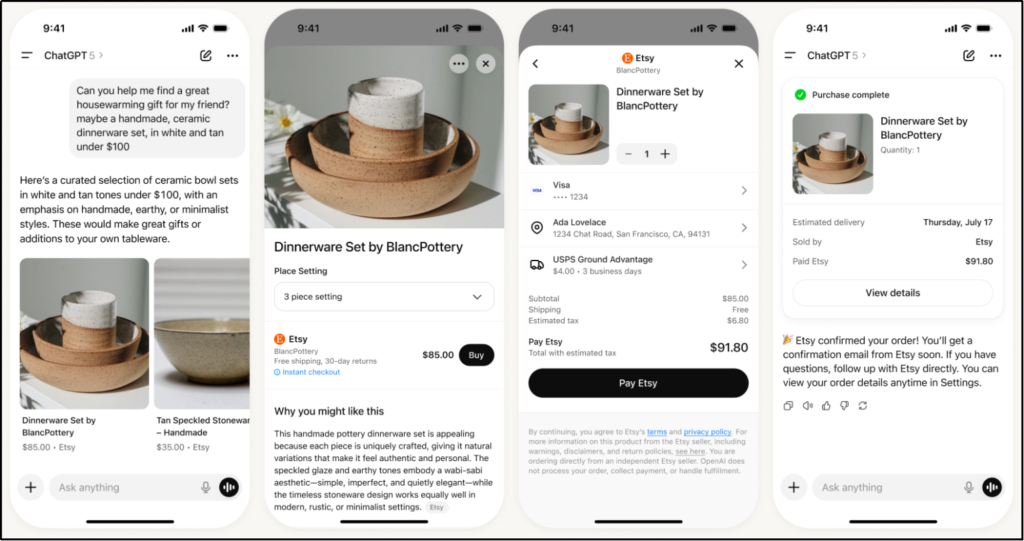
Currently, Instant Checkout supports single-item purchases from U.S.-based Etsy sellers. Soon, it will roll out to more than one million Shopify merchants, including leading brands such as Glossier, SKIMS, and Spanx.
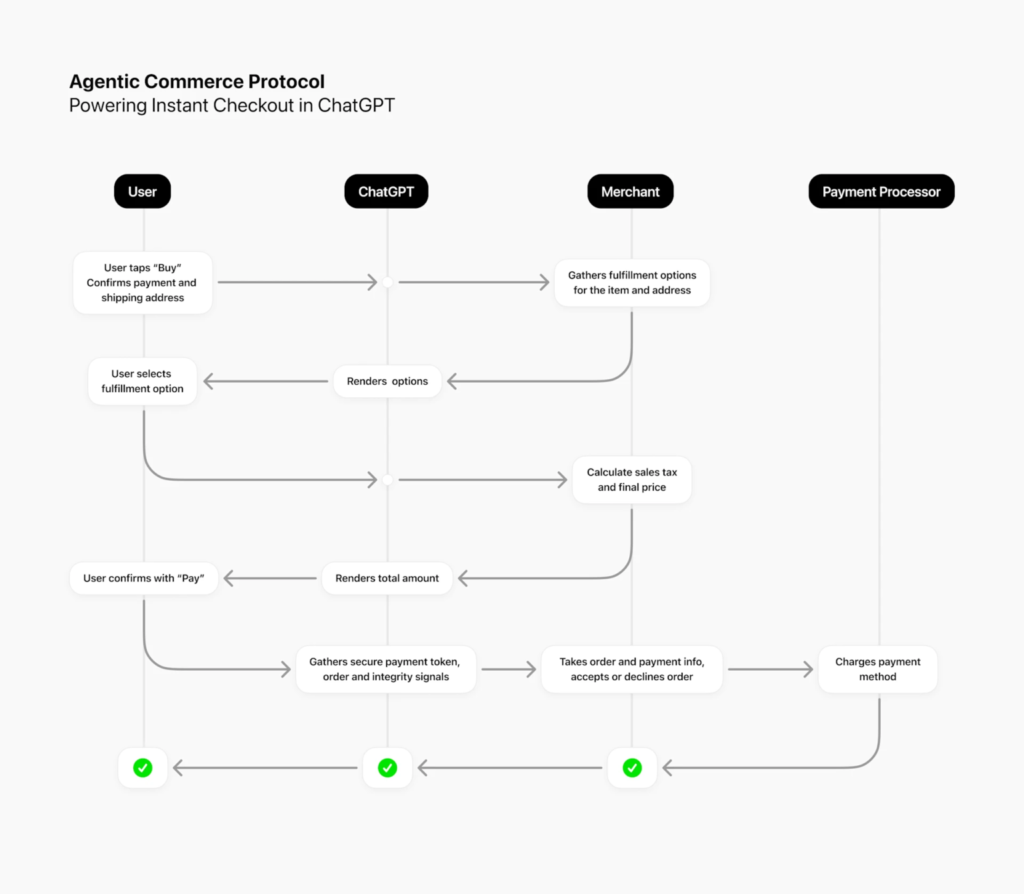
Image Source: https://openai.com/index/buy-it-in-chatgpt
How Pricing, Ranking, and Transactions Work
For merchants, the model is simple and transparent. You pay a small fee only when a transaction is completed. There’s no impact on your product pricing and no paid placement or preferential treatment in ChatGPT’s rankings.
For users, the experience is free, secure, and fully transparent.
When multiple merchants offer the same product, ChatGPT ranks options based on a combination of factors, including:
- Product availability
- Price competitiveness
- Product quality and relevance
- Whether the merchant is the primary seller
- Whether Instant Checkout is enabled
3.3 What Are ChatGPT Product Feeds and How Do They Work?
A ChatGPT product feed is a structured data fileCSV, TSV, XML, or JSON that contains your complete product catalog in the exact format defined by OpenAI’s Product Feed Specification.
Unlike organic product discovery, which relies on crawling your website, ChatGPT product feeds act as the source of truth. The data you submit is what ChatGPT trusts and uses when recommending or selling your products.
Each feed includes the core information ChatGPT needs to surface and transact products effectively:
- Essential product data: product ID, SKU, title, description, and product URL
- Pricing and availability: price, sale price, and inventory levels
- Rich media assets: primary image, additional images, videos, and 3D model links
- Merchant details: brand name, seller URL, and store policies
- OpenAI control flags: settings such as enable search and enable checkout to determine visibility and Instant Checkout eligibility
Beyond the basics, merchants can include advanced attributes such as promotions, variant data, fulfillment timelines, return policies, performance signals, compliance information, reviews, and Q&A. These enhancements improve relevance and increase the likelihood of being recommended in ChatGPT results.
How OpenAI Processes Product Feeds
Once submitted, your product feed moves through four key stages:
- Ingestion – OpenAI receives your file
- Validation – Each field is checked against official feed requirements
- Indexing – Products are organized so ChatGPT can surface them in conversations
- Continuous refreshing – Updates are accepted every 15 minutes to maintain real-time accuracy
In short, your product feed becomes the authoritative record ChatGPT uses for pricing, availability, descriptions, and checkout. It’s the backbone of AI-driven commerce structured, reliable, and always up to date.
As AI-first discovery models continue to grow beyond Google, brands and agencies must evolve their SEO strategies to account for how AI systems now surface and rank products.
How to Get Your Products on ChatGPT
4.1 How to Appear in Organic ChatGPT Shopping Results
As AI-powered shopping accelerates, visibility inside ChatGPT is becoming a core component of modern eCommerce SEO. Even without submitting a product feed, merchants can earn organic exposure through strong technical foundations and well-optimized product pages.
If you’re not ready for direct feed integration, start here:
- Audit your robots.txt
Ensure OAI-SearchBot is allowed to crawl your product pages. If the bot is blocked, your products won’t appear.
- Implement structured data
Use complete schema.org/Product markup, including price, availability, ratings, brand, and variants, to help ChatGPT extract accurate product information.
- Optimize for conversational intent
Write product descriptions that match how people naturally search (e.g., “durable work shoes for standing all day” instead of “men’s steel-toe boots”).
- Monitor analytics
Track referrals from ChatGPT using utm_source=chatgpt.com in Google Analytics.
- Register for the product feed program
Submit OpenAI’s interest form to prepare for future direct feed access.
When these elements work together, your product pages become more crawlable, more relevant, and better aligned with ChatGPT’s ranking signals even without a submitted feed.
Want to see how your store performs in AI search?
Get an Ecommerce AI Search Audit to understand where your products appear and where they’re missing out across ChatGPT and other AI platforms.
4.2 How to Submit Your Product Feed to ChatGPT
Ready to move from being searchable to shoppable inside ChatGPT?
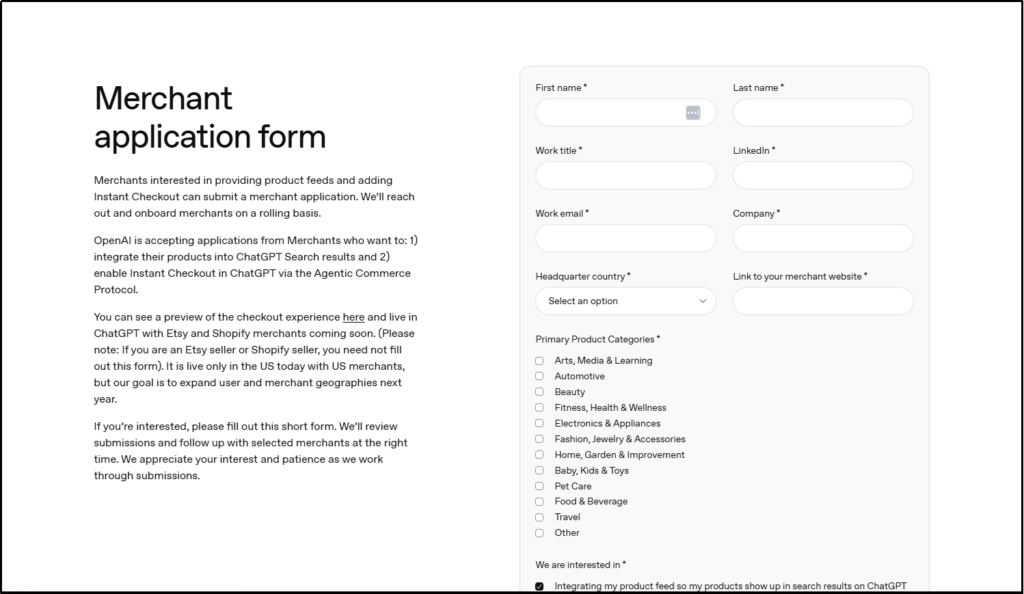
Merchants can now apply to submit product feeds and enable Instant Checkout. Approved catalogs appear directly in ChatGPT Shopping results and unlock the full capabilities of the Agentic Commerce Protocol (ACP).
OpenAI is currently partnering with Etsy and Shopify merchants, with additional platforms coming soon. At present, eligibility is limited to U.S.-based merchants, though global expansion is expected.
Step-by-step process:
- Apply via chatgpt.com/merchants
Submit your business information, product catalog details, and payment setup to begin the onboarding process.
- Get Approved
OpenAI reviews your application and issues secure HTTPS endpoint credentials for submitting your product feed.
- Choose a File Format
Select the format that best fits your technology stack: CSV, TSV, XML, or JSON.
- Build Your Feed with Required Fields
Include the following mandatory attributes:
- id – Unique product identifier
- title – Conversational product title (≤150 characters)
- description – Natural-language description (≤5,000 characters)
- link – Product URL
- image_link – Primary image URL
- price – Current price
- availability – Stock status
- inventory_quantity – Units available
- enable_search – true/false
- enable_checkout – true/false
Optional fields such as promotions, reviews, Q&A, variants, and store policies can further improve your visibility and relevance in ChatGPT’s rankings.
- Validateand Upload
Run validation checks, submit your feed, and set up automatic refresh cycles every 15 minutes to keep your catalog up to date.
- Monitor Performance
Track key metrics like impressions, click-through rate (CTR), and conversions to understand how your products perform inside ChatGPT Shopping.
4.3 Enabling Instant Checkout
Instant Checkout enables users to complete purchases directly inside ChatGPT fast, secure, and seamless.
You can enable it in two ways:
If You Use Stripe
Activate Agentic Commerce with just one line of code.
If You Use a Different Payment Processor
You can still participate without rebuilding your backend by using:
- Stripe’s Shared Payment Token API, or
- The Delegated Payments Specification
Both options allow you to maintain your existing customer relationships, fulfillment workflows, and payment systems while enabling native checkout inside ChatGPT.
Ecommerce SEO Strategies to Maximize Visibility in ChatGPT Shopping
To win inside ChatGPT Shopping, your product content must do more than rank it must communicate clearly. ChatGPT favors products that are helpful, context-rich, and easy to understand. Here are the essential optimization strategies every merchant should follow:
1) Write Conversational, Intent-Driven Titles
Traditional SEO: “Nike Air Zoom Pegasus 40”
ChatGPT-Optimized SEO: “Nike Air Zoom Pegasus 40 Men’s Lightweight Running Shoes for Long-Distance Comfort”
This enriched title helps ChatGPT understand the use case, fit, and intent boosting your chances of being recommended for relevant queries.
2) Enrich Descriptions with FAQ-Style Answers
ChatGPT favors structured clarity. Adding FAQ blocks improves semantic relevance and addresses the questions shoppers commonly ask.
Example:
- Q: Is this waterproof?
A: Yes, it features a Gore-Tex upper for all-weather protection.
- Q: How long is the break-in period?
A: Most runners feel fully comfortable after 2–3 runs.
This format gives ChatGPT ready-made responses to use in recommendations.
3) Highlight Trust Signals
Social proof increases confidence, and ChatGPT uses these signals to assess product quality. Include:
- Return and refund policies
- Review ratings
- Shipping timelines
- Stock levels
- Warranty information
The clearer your trust signals, the more likely ChatGPT is to surface your product for queries like “reliable,” “top-rated,” or “best-reviewed.”
4) Provide Complete Variant Data
Variant completeness is critical. ChatGPT needs accurate metadata to recommend the correct color, size, or material.
- Include all variants in your feed or structured data
- Use item_group_id to link related SKUs
- Avoid orphan variants with missing information
A complete variant tree improves recommendation consistency and relevance.
5) Refresh Your Data Frequently
ChatGPT penalizes stale or inconsistent information. Keep these elements up to date:
- Price
- Sale price
- Stock levels
- Variant availability
- Shipping timelines
Once your feed is active, refresh at least daily ideally every 15 minutes. Fresh data signals reliability and boosts both visibility and user trust.
- Technical Submission Examples (New Set)
Below are updated examples showing how merchants can format and submit product feeds to ChatGPT using CSV, JSON, and a sample cURL upload request.
CSV Example (New Product Example)
id,title,description,link,image_link,price,availability,inventory_quantity,enable_search,enable_checkout,brand,product_category,color,size
SKU98765,Premium Bamboo Bath Towel,”Ultra-soft, fast-drying bamboo towel ideal for sensitive skin”,https://store.com/p/SKU98765,https://store.com/images/SKU98765.jpg,”29.50 USD”,in_stock,120,true,true,SoftWeave,”Home & Garden > Bath”,”Ivory”,”Large”
JSON Example (New Product Example)
{
“id”: “SKU98765”,
“title”: “Premium Bamboo Bath Towel”,
“description”: “Ultra-soft, fast-drying bamboo towel ideal for sensitive skin”,
“link”: “https://store.com/p/SKU98765”,
“image_link”: “https://store.com/images/SKU98765.jpg”,
“price”: “29.50 USD”,
“availability”: “in_stock”,
“inventory_quantity”: 120,
“enable_search”: true,
“enable_checkout”: true,
“brand”: “SoftWeave”,
“product_category”: “Home & Garden > Bath”,
“color”: “Ivory”,
“size”: “Large”
}
Example Upload (cURL)
curl -X POST “https://{openai-merchant-endpoint}/feeds/upload”
-H “Authorization: Bearer {YOUR_API_KEY}”
-H “Content-Type: application/json”
–data-binary @bamboo_towel_feed.json
White-Label Opportunities for Digital Agencies
The rise of ChatGPT-driven eCommerce has created a major gap in the agency landscape: most agencies lack the internal expertise, tools, and processes needed to optimize for ChatGPT, AI search, product feeds, and Instant Checkout.
This is where white-label eCommerce SEO services deliver real value.
A white-label partner enables agencies to offer complete ChatGPT eCommerce SEO solutions without hiring new staff, building complex technical workflows, or mastering product feed systems. The partner handles implementation and execution, while the agency retains full client ownership and controls pricing.
What a White-Label Partner Handles
- Product feed creation and optimization
- Ongoing feed management and troubleshooting
- ChatGPT discovery optimization
- Structured data and schema implementation
- Instant Checkout setup (Shopify, Etsy, and future platforms)
- AI search performance tracking and reporting
Service Packages Agencies Can Offer
- ChatGPT Discovery Optimization
- Product Feed Setup & Management
- Full AI Commerce Stack (including Instant Checkout)
This model allows agencies to scale faster, improve client outcomes, and enter the AI commerce space immediately without any internal overhead.
What’s Next for ChatGPT Shopping Revenue in 2026
Product visibility in ChatGPT is not a future opportunity it’s happening now.
ChatGPT’s shopping discovery feature and Instant Checkout are already live on platforms like Etsy, with Shopify rollout underway. The ecosystem is active and ready.
The question is not if ChatGPT will become a major shopping channel.
It already is.
Brands that act early by implementing product feeds, structured data, AI search optimization, and checkout readiness will capture a disproportionate share of this new traffic. Those who delay will be forced to play catch-up.
What to Do Next
For eCommerce brands:
Start with a ChatGPT SEO audit to assess site accessibility, structured data quality, and feed readiness.
For digital agencies:
Partner with a white-label provider to instantly expand into AI eCommerce SEO services without additional hiring or training.
The AI shopping revolution has already begun.

Mitesh Patel is the co-founder of 247 Digital Marketing, LawFirm Marketing and a columnist. He helps companies like Emerson and other top Fortune 500 compnies to grow their revenue.