Artificial intelligence is transforming the way businesses develop products, serve customers, and compete in the digital marketplace. From AI-powered SaaS platforms and automation tools to machine learning applications and enterprise technologies, new AI solutions are entering the market every day. As competition continues to grow, AI Marketing has become an important part of helping businesses communicate their technology, reach the right audiences, build credibility, and generate sustainable growth.
However, creating a powerful AI product is only one part of building a successful business. Companies also need to communicate their value clearly, reach the right audience, establish credibility, and create a reliable path from awareness to conversion.
This is where an experienced AI product marketing agency can make a meaningful difference.
AI product marketing requires more than traditional advertising. It involves market research, product positioning, audience segmentation, content development, demand generation, search optimization, and continuous campaign testing. Marketing teams must also turn complex technical capabilities into clear benefits that customers can easily understand.
Below, we explore 10 agencies with different strengths across AI, SaaS, B2B, content, public relations, growth marketing, technical communications, and digital strategy.
Why AI Product Marketing Requires a Different Approach
The AI marketplace is becoming increasingly competitive. New applications, platforms, models, and tools are launched constantly, and many products offer similar features.
As a result, simply describing a product as “AI-powered” is no longer enough.
Today’s buyers want clear answers to questions such as:
- What problem does the product solve?
- How is it different from competing solutions?
- What measurable results can customers achieve?
- How easily can it fit into existing workflows?
- Is the technology reliable and scalable?
- Why should customers trust the product?
- Does the solution provide meaningful business value?
An effective marketing strategy should therefore focus on outcomes rather than technical features alone.
For example, instead of simply explaining that a platform uses machine learning, strong product marketing should show how that technology can improve productivity, reduce operational complexity, accelerate decision-making, or solve a specific business challenge.
Businesses looking for support from a Digital Marketing Agency in USA may also benefit from an integrated strategy that combines content, search, paid campaigns, social media, conversion optimization, and brand development.
AI markets can change quickly, which makes flexibility equally important. New competitors, product updates, model releases, and changing customer expectations can all influence positioning. Marketing strategies should therefore be continuously reviewed and refined.
What Makes a Strong AI Product Marketing Agency?
Choosing an agency should involve more than reviewing its service list. The right partner should understand the unique challenges associated with AI products and technical businesses.
- AI and Technical Experience
An agency should be comfortable working with technical products, SaaS platforms, data solutions, automation systems, developer tools, or artificial intelligence technologies.
Technical understanding allows marketers to create content that remains accurate while making complex concepts accessible to business decision-makers.
- Product Marketing Expertise
Product marketing involves much more than promotion. It includes positioning, messaging, customer research, competitive analysis, product launches, pricing communication, sales enablement, and go-to-market planning.
An experienced agency should understand how these elements work together.
- Proven Results
Case studies can provide valuable insight into an agency’s capabilities. Look for evidence of improvements in areas such as:
- Qualified leads
- Pipeline growth
- Organic traffic
- Conversion rates
- Customer acquisition
- Product adoption
- Search visibility
- Brand awareness
Specific results generally provide more value than broad marketing claims.
- Full-Funnel Capabilities
AI product marketing often requires several channels working together.
Depending on the business, an agency may need to coordinate SEO, paid advertising, content marketing, social media, public relations, webinars, email marketing, account-based marketing, and conversion optimization.
A connected strategy can create a more consistent customer journey.
- Understanding of AI Search
Search behavior is evolving. Potential customers increasingly discover information through AI-powered search experiences, answer engines, and traditional search platforms.
Marketing agencies should understand how content can be structured to improve visibility across these changing discovery channels.
Top 10 AI Product Marketing Agencies
1. 247 Digital Marketing
247 Digital Marketing provides comprehensive digital marketing solutions designed to help businesses strengthen their online presence, attract qualified audiences, and generate sustainable growth. Its approach can combine AI Marketing, SEO, content marketing, paid advertising, social media marketing, website optimization, and conversion strategies to help AI businesses reach the right audience and communicate complex products clearly.
For AI and technology businesses, this type of approach can help simplify complex product messaging and communicate value to potential customers across multiple digital touchpoints.
Key strengths
- Digital marketing strategy
- SEO
- Content marketing
- Paid advertising
- Social media marketing
- Website optimization
- Conversion optimization
- Lead generation
- AI-focused marketing strategies
Best for
AI startups, SaaS companies, technology businesses, and growing brands looking for an integrated digital marketing strategy may benefit from a full-service approach.
2. Foundation
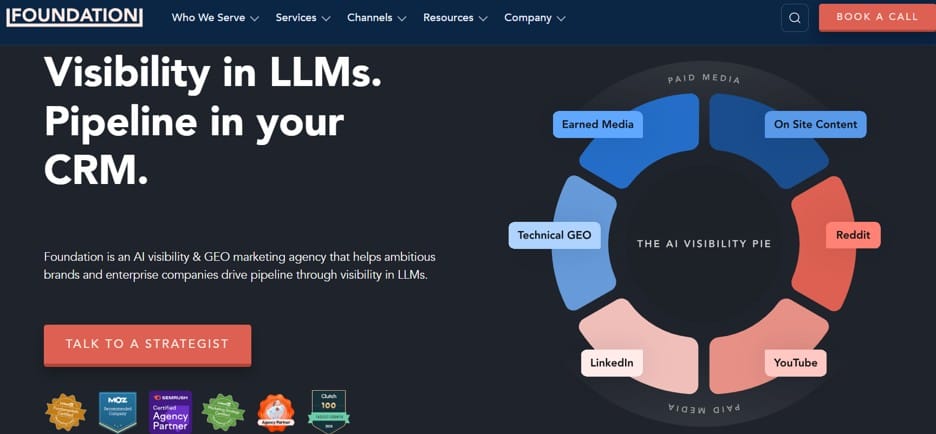
Foundation takes a content-driven approach to digital growth. Its work combines AI Marketing, audience research, competitive analysis, content strategy, SEO, distribution, and multi-channel marketing to help businesses establish authority and attract relevant customers.
This approach can be particularly useful for businesses that want to establish authority and attract customers through educational content.
Key strengths
- Content marketing
- SEO
- Audience research
- Competitive analysis
- Social distribution
- Thought leadership
- Product storytelling
Best for
AI and SaaS businesses looking to improve organic visibility and build a scalable content strategy may find this approach valuable.
3. Growth Division
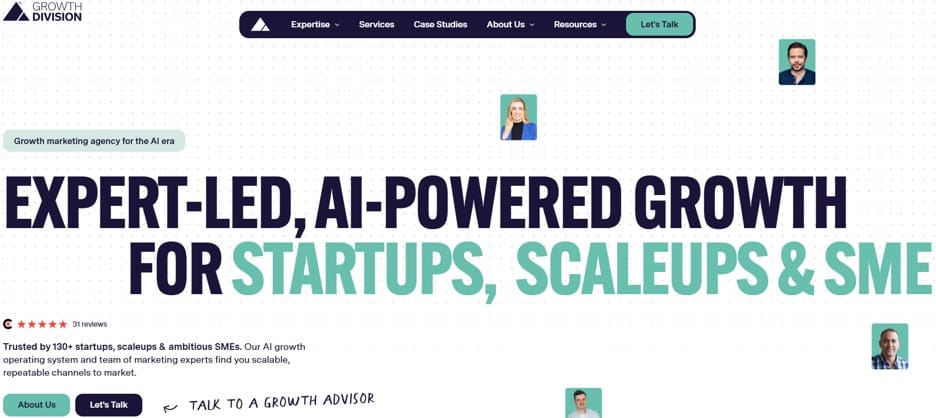
Growth Division focuses on growth marketing and experimentation. Its strategy can incorporate AI Marketing, acquisition testing, campaign measurement, channel optimization, and repeatable growth systems to help companies identify effective ways to reach and convert their audiences.
Experimentation can be especially useful for AI startups that are still determining which channels and audiences generate the strongest results.
Key strengths
- Growth experimentation
- Acquisition strategy
- Demand generation
- Marketing technology
- Channel testing
- Data-driven optimization
- Go-to-market support
Best for
Early-stage AI companies that need to test acquisition channels and develop a scalable marketing process can benefit from this approach.
4. Salient

Salient focuses on public relations and brand positioning for technology companies. Its approach can complement AI Marketing with technology PR, media relations, thought leadership, brand storytelling, product launches, and executive positioning.
For AI businesses competing in rapidly developing markets, public relations can help turn technical innovation into stories that customers, journalists, investors, and industry professionals can understand.
Key strengths
- Technology PR
- Media relations
- Thought leadership
- Brand storytelling
- Product launches
- Executive positioning
- Earned media
Best for
AI companies seeking greater visibility, credibility, and industry recognition may benefit from a PR-focused marketing strategy.
5. Upgrow
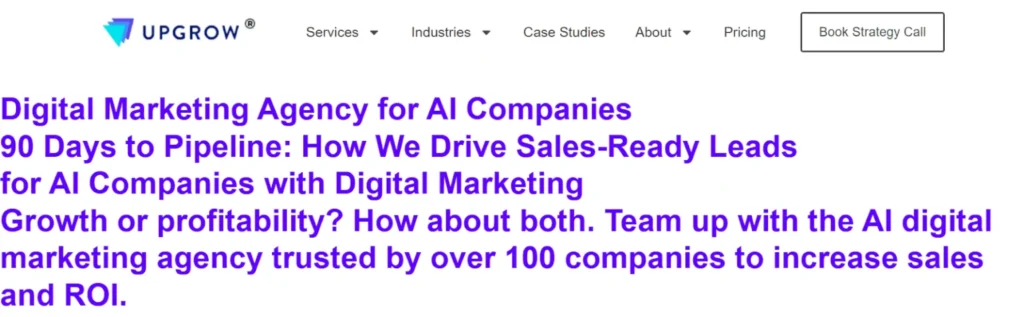
Upgrow provides digital marketing services designed to connect acquisition, optimization, and business growth. Its approach can incorporate AI Marketing alongside SEO, paid advertising, conversion optimization, lead generation, and marketing automation.
For businesses evaluating Digital Marketing Services New York, this type of full-funnel approach can be useful when the goal is to connect traffic generation with measurable conversions and business outcomes.
Key strengths
- SEO
- Paid media
- Conversion optimization
- Lead generation
- Marketing automation
- Performance marketing
- Funnel optimization
Best for
AI companies with a defined target audience that want to improve qualified traffic, lead generation, and conversion performance may find this model suitable.
6. Goviral Global

Goviral Global focuses on influencer marketing and user-generated content. Its strategy can combine AI Marketing with creator campaigns, social media marketing, user-generated content, brand awareness, and community-focused promotion.
AI products that depend on social awareness, creator communities, product demonstrations, or consumer adoption can use influencer campaigns to introduce their solutions to new audiences.
Key strengths
- Influencer marketing
- User-generated content
- Creator campaigns
- Social media marketing
- Brand awareness
- International campaigns
- Community-focused promotion
Best for
Consumer-facing AI applications and products that rely heavily on social discovery can benefit from influencer-driven campaigns.
7. Team 4
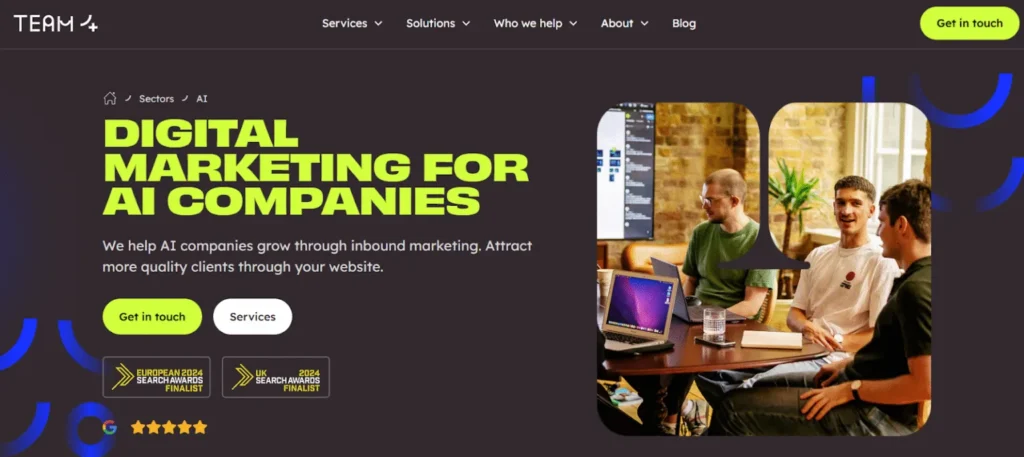
Team 4 combines website development with inbound marketing and SEO. Its digital strategy can incorporate AI Marketing alongside website development, content strategy, inbound marketing, organic acquisition, and SaaS website optimization.
For AI and SaaS companies, a website often serves as one of the most important channels for educating prospects and generating conversions. A strong website should communicate the product’s value quickly while supporting long-term organic growth.
Key strengths
- Website development
- SEO
- Web design
- Inbound marketing
- Content strategy
- Organic acquisition
- SaaS website optimization
Best for
AI startups and SaaS companies that need to improve their website, strengthen search visibility, and develop a stronger inbound marketing system may benefit from this combination.
8. Ten Speed
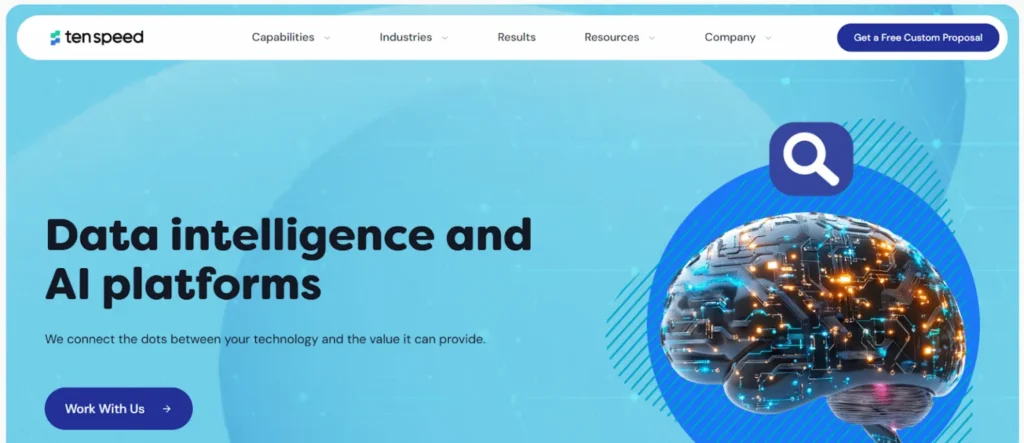
Ten Speed specializes in digital marketing and content for technology and data-focused businesses. Its approach can integrate AI Marketing with technical positioning, research-driven content, SEO, search optimization, and thought leadership.
AI and data products can be difficult to explain because their value often depends on technical concepts. High-quality content can bridge the gap between complex functionality and practical business outcomes.
Key strengths
- Content marketing
- SEO
- Technical positioning
- Research-driven content
- AI and data marketing
- Search optimization
- Thought leadership
Best for
AI platforms and data companies that need to explain complex products to technical and executive audiences can benefit from specialized content and search strategies.
9. VSC
VSC is known for technology-focused public relations and narrative development. Its communications strategy can work alongside AI Marketing through brand storytelling, founder positioning, media relations, thought leadership, and category development.
AI companies often need more than product promotion. They need a clear story explaining why their technology matters, which problem they are addressing, and how their solution fits into a broader market.
Key strengths
- Public relations
- Brand storytelling
- Founder positioning
- Media relations
- Thought leadership
- Category creation
- Technology communications
Best for
AI businesses pursuing major product launches, fundraising, enterprise credibility, or increased market recognition may benefit from strategic communications.
10. Infrasity
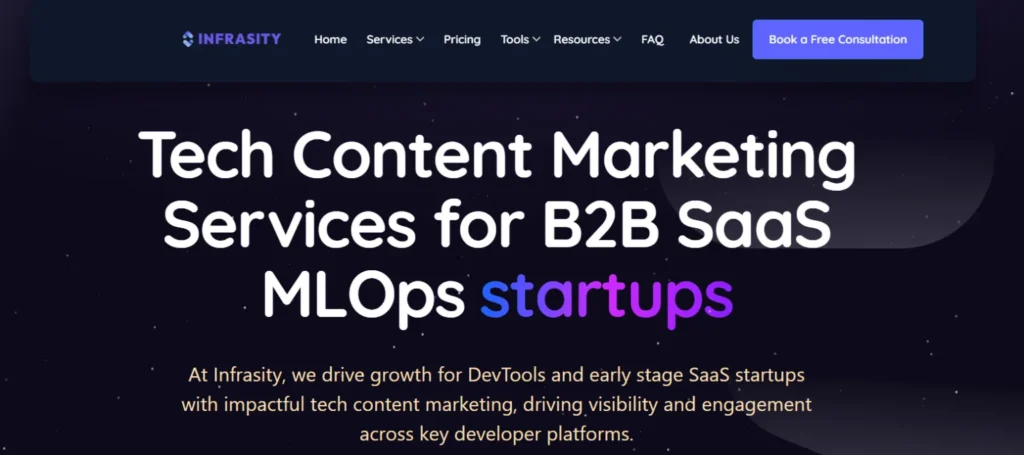
Infrasity focuses on technical content marketing, particularly for developer tools, cloud infrastructure, DevOps, MLOps, and AI technologies. Its approach can combine AI Marketing with technical content, developer-focused marketing, SEO, educational content, and search optimization.
Technical buyers often require detailed information before adopting a product. Generic marketing content may not provide enough depth to answer their questions or demonstrate technical expertise.
Key strengths
- Technical content
- Developer-focused marketing
- SEO
- DevTools marketing
- Cloud technology content
- MLOps content
- Educational videos
Best for
AI infrastructure companies, developer platforms, and technically complex startups that need expert-level educational content may find this specialized approach useful.
How to Choose the Right AI Product Marketing Agency
There is no single agency that works perfectly for every AI company. The right choice depends on your product, audience, business stage, budget, and growth objectives.
Before selecting a partner, consider the following factors.
For Early-Stage AI Startups
Early-stage companies often need help defining their ideal customer profile, refining messaging, validating positioning, and developing an initial go-to-market strategy.
At this stage, strategic planning and customer research can be more important than simply increasing advertising spend.
Consider whether the agency can help answer:
- Who is the ideal customer?
- What specific problem does the product solve?
- What makes the solution different?
- Which customer segments have the strongest potential?
- Which acquisition channels should be tested first?
For Scaling AI Companies
Once an AI product has established product-market fit, the marketing focus often shifts toward scaling.
Companies may need:
- Multi-channel demand generation
- Content expansion
- SEO growth
- Paid acquisition
- Account-based marketing
- Brand development
- Sales enablement
- Conversion optimization
At this stage, the agency should be able to connect marketing activities to measurable business objectives.
For Enterprise AI Products
Enterprise AI products typically involve longer buying cycles and multiple stakeholders.
Marketing may need to address executives, technical teams, procurement departments, security professionals, and end users.
An agency should therefore be able to develop audience-specific messaging while maintaining a consistent product narrative.
When evaluating an SEO Company in New York, for example, an AI business should look beyond rankings and ask how search strategy will support qualified traffic, authority, conversions, and long-term business growth.
Questions to Ask Before Hiring an AI Marketing Agency
Before signing an agreement, ask potential partners practical questions about their experience and process.
What AI products have you worked with?
Relevant experience can be more valuable than general marketing experience when the product is technically complex.
How do you define success?
A good agency should explain how its work connects to meaningful business outcomes.
How do you develop positioning?
Ask how the agency research customers, competitors, market trends, and product differentiators.
How do you measure performance?
Depending on your goals, useful metrics can include qualified pipeline, conversion rates, customer acquisition costs, organic visibility, engagement, and revenue contribution.
How will you work with our internal team?
A successful agency relationship requires collaboration between marketing, product, sales, leadership, and sometimes engineering teams.
How quickly can your strategy adapt?
AI markets can change rapidly. Your marketing partner should have a process for testing new ideas, analyzing results, and updating campaigns when market conditions change.
Red Flags to Watch For
Not every agency claiming AI expertise has meaningful experience with AI products.
Be cautious if an agency:
- Focuses mainly on producing large volumes of AI-generated content
- Cannot provide relevant examples of previous work
- Talks only about impressions or traffic
- Has no clear positioning methodology
- Does not understand your target audience
- Makes unrealistic promises about immediate results
- Cannot explain how marketing connects to revenue
- Uses the same strategy for every client
AI product marketing requires strategic thinking, technical understanding, audience research, and continuous optimization.
What an AI Product Marketing Agency Can Help With
A specialized agency can support multiple stages of the marketing process.
Market Research
Research helps identify target customers, competitors, industry trends, purchasing behavior, and potential market opportunities.
Positioning
Strong positioning communicates what the product does, who it serves, which problem it solves, and why customers should consider alternatives.
Messaging
Messaging translates technical capabilities into benefits that different audiences can easily understand.
Go-to-Market Strategy
A go-to-market plan determines how a product will reach customers, which channels should be prioritized, and how prospects will move through the buying journey.
Content Marketing
Educational articles, comparison pages, case studies, technical guides, videos, and other content can help prospects understand complex AI products.
Search Optimization
SEO can increase the chances of a product being discovered when potential customers research solutions online. Content should also be structured to support visibility across evolving AI-powered search experiences.
Demand Generation
Demand-generation campaigns create awareness and generate qualified opportunities through channels such as paid media, content, webinars, social platforms, and email.
Public Relations
PR can help establish credibility, generate media attention, and position a company within a developing market category.
Conversion Optimization
Strong traffic is only valuable when visitors take meaningful actions. Conversion optimization can improve landing pages, forms, product pages, demo requests, and other customer touchpoints.
AI Product Marketing Checklist
Before working with an agency, make sure your business can answer the following questions:
- Who is our primary target customer?
- What specific problem does our AI product solve?
- What makes our solution different?
- Do we have validated customer use cases?
- Which marketing channels currently generate results?
- What are our biggest growth challenges?
- Do we need positioning, content, demand generation, or a combination?
- What are our primary business goals for the next 6–12 months?
- Which metrics will determine success?
- Do we have enough internal resources to collaborate with an agency?
- Is our marketing budget realistic for a sustained campaign?
The clearer these answers are, the easier it becomes to identify the right marketing partner.
Final Thoughts
AI product marketing has become increasingly competitive as more businesses enter the artificial intelligence market. Companies can no longer depend on technical innovation alone to attract attention and generate demand.
Successful AI marketing combines clear positioning, compelling storytelling, audience research, credible proof, effective distribution, search visibility, and continuous optimization.
The agencies discussed above represent different approaches, including product positioning, growth marketing, SEO, content marketing, public relations, influencer campaigns, and technical communications.
The best choice ultimately depends on your company’s stage and objectives. An early-stage startup may need help defining its market and messaging, while a growing AI company may require a complete demand-generation system. Enterprise products may need a combination of thought leadership, technical content, account-based marketing, and stakeholder-specific messaging.
Before choosing an agency, evaluate its relevant experience, strategic process, communication style, measurable results, and ability to understand your product. The right partner should do more than increase marketing activity it should help you communicate your value clearly, reach the right audience, build trust, and create sustainable growth.

Mitesh Patel is the co-founder of 247 Digital Marketing, LawFirm Marketing and a columnist. He helps companies like Emerson and other top Fortune 500 compnies to grow their revenue.