
How AI Will Transform Digital Marketing by 2026: Trends, Tools, Pros, Cons, and the Future Ahead
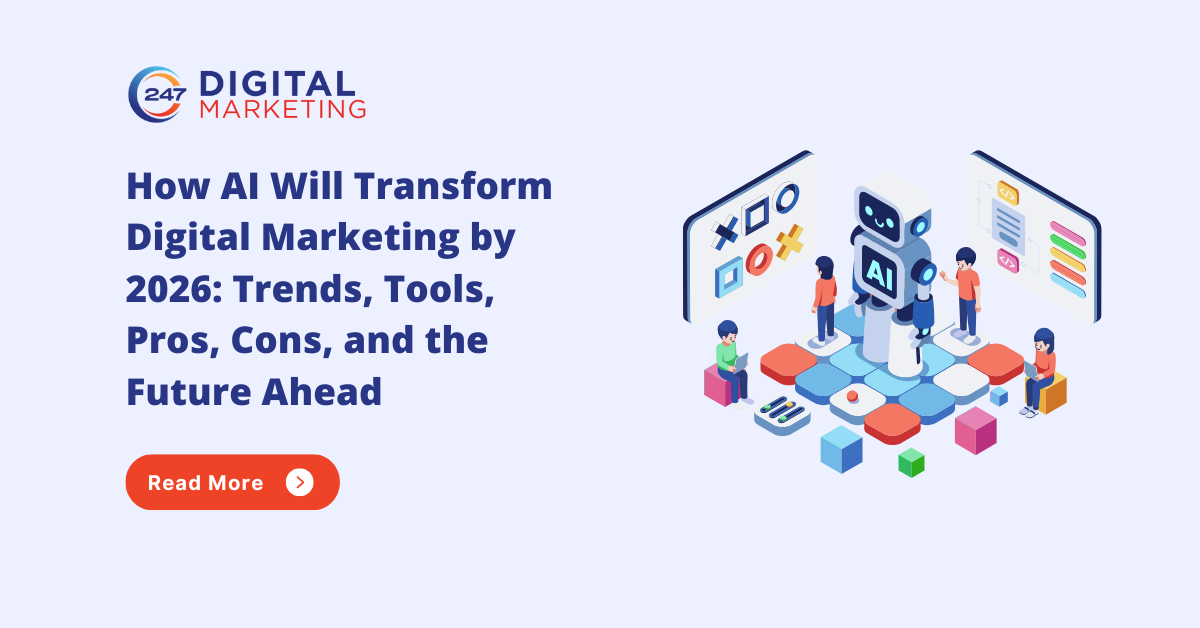
Digital marketing has always been shaped by technology from the early days of banner ads to the rise of social media marketing, mobile-first content, and data-driven campaigns. But no technological shift has been as rapid, influential, or transformative as the rise of artificial intelligence (AI). By 2026, AI will no longer be a tool that marketers selectively experiment with; it will be the foundation of every major marketing strategy, customer experience initiative, and content workflow.
AI is already reshaping how businesses attract audiences, personalize engagement, analyze data, automate campaigns, and measure success. But the real revolution is just beginning. As machine learning (ML), natural language processing (NLP), predictive analytics, and generative AI tools advance at lightning speed, marketers who adapt now will hold a decisive competitive edge in the years ahead.
This comprehensive guide explores how AI will impact digital marketing by 2026, the benefits and drawbacks of widespread AI adoption, the emerging technologies powering this shift, and the practical steps brands should take to prepare. Whether you’re a business owner, marketer, or strategist, this is your roadmap for navigating the AI-driven marketing world of tomorrow.
AI-Powered Hyper-Personalization: The New Marketing Standard
For decades, marketers have attempted to personalize content, but true personalization was limited by technology. AI is changing that permanently. By 2026, personalization will go beyond using a customer’s first name or recommending similar products it will be deep, predictive, and dynamic across every touchpoint.
How Hyper-Personalization Works
AI analyzes massive datasets instantly, including:
- Browsing history
- Previous purchases
- Location
- Search behavior
- Social media activity
- Email engagement
- Device usage
- Real-time behavior (e.g., time spent on a page)
This allows brands to deliver content that feels uniquely tailored to each individual automatically.
Imagine:
- A website that changes its layout, product recommendations, and messaging in real time for each visitor.
- Emails where not just the subject line but the imagery, copy, and offers adjust based on predicted buying behavior.
- Ads that dynamically tailor visuals and CTAs to match a user’s interests the second they load.
These aren’t futuristic ideas they are becoming mainstream.
Why Personalization Matters in 2026
Hyper-personalization leads to:
- Higher engagement
- Increased conversions
- Improved customer retention
- More efficient ad spend
- Stronger brand loyalty
Audiences expect relevance. By 2026, generic marketing campaigns will feel outdated and ineffective. Brands that fail to personalize at scale will fall behind competitors that use AI to deliver meaningful, context-aware experiences. Partnering with a Digital Marketing Agency in USA can help companies achieve this level of personalization.
Automation and Efficiency: AI as the New Marketing Engine
One of the most immediate impacts of AI is automation. Marketing teams are used to juggling countless tasks that consume time posting on social media, adjusting ad budgets, running A/B tests, sorting leads, responding to inquiries, and more.
AI handles these repetitive tasks instantly, freeing marketers to focus on strategy and creativity.
How AI Automation Works
AI tools can now:
- Auto-schedule posts based on when audiences engage most
- Dynamically optimize ad spend across channels
- Run multivariate tests to identify top-performing content
- Create multiple ad or email variations automatically
- Manage email workflows based on user behavior
- Score and segment leads
- Trigger campaigns based on predictive insights
- Generate performance reports in seconds
This shift fundamentally changes how marketing teams operate.
AI doesn’t replace marketers it acts as a powerful assistant, doing the heavy lifting while humans steer strategy, storytelling, and ideation.
The Real Impact on Marketing Teams
By 2026, AI automation will allow marketers to:
- Produce more campaigns in less time
- Respond to customers and leads instantly
- Avoid manual data entry and analysis
- Reallocate time toward creativity and relationships
- Reduce wasted ad spend
- Achieve higher ROI with less effort
The result? More effective campaigns, faster execution, and more sustainable growth.
Predictive Analytics: Anticipating Customer Behavior Before It Happens
If personalization is the heart of AI in marketing, predictive analytics is the brain.
Predictive analytics uses machine learning to analyze historical and real-time data to forecast future outcomes. Instead of reacting to trends, marketers will be able to anticipate them.
What Predictive Analytics Can Do
By 2026, AI will enable marketers to:
- Predict when customers are most likely to buy
- Identify customers at risk of churn
- Forecast sales and campaign performance
- Recommend optimal content and messaging
- Determine the best channels for each user segment
- Anticipate seasonal or behavioral trends
- Minimize wasted ad spend
Imagine knowing exactly:
- Which customers are ready to upgrade
- Which leads will convert
- What content topic will trend next month
- When a user is likely to unsubscribe
- Which product will become the next bestseller
This is the power of predictive intelligence.
The Strategic Advantage
Brands that harness predictive analytics gain:
- More accurate planning
- Better budget allocation
- Lower acquisition costs
- Higher customer lifetime value
- Real-time optimization across platforms
By 2026, predictive analytics will make marketing more proactive, agile, and insight-driven than ever before.
AI in Content Creation, Curation, and Optimization
Content remains the backbone of digital marketing, but AI is rewriting the rules.
AI can now generate:
- Blogs
- Social media posts
- Ads
- Emails
- Product descriptions
- Graphics
- Videos
- Interactive content (quizzes, calculators, etc.)
Beyond creation, AI tools help analyze performance, optimize headlines, recommend keywords, and identify trending topics before they spike.
The Era of AI-Generated Content (With Human Oversight)
AI accelerates content creation, but brands must maintain quality and authenticity. Humans remain essential to:
- Craft compelling narratives
- Ensure brand voice consistency
- Add emotional nuance
- Validate facts and accuracy
- Create original perspectives
In 2026, the most successful brands will use AI and human creativity together. AI will provide speed, scale, and data insights while humans supply imagination, strategy, and authenticity.
AI-Driven Content Curation
AI can also curate content by:
- Recommending relevant articles
- Organizing newsletters
- Surfacing trending topics
- Personalizing content feeds
This helps brands stay relevant without constantly producing content manually.
AI-Enhanced Customer Experience: Faster, Smarter, Seamless
Customer experience (CX) is becoming the ultimate brand differentiator. And AI is transforming every touchpoint.
Chatbots, Virtual Assistants, and Conversational AI
Chatbots today do more than answer FAQs they can:
- Process orders
- Resolve complaints
- Recommend products
- Troubleshoot issues
- Offer personalized support
- Integrate with CRM systems
- Provide 24/7 service
By 2026, conversational AI will be nearly indistinguishable from human support in many interactions.
AI-Powered Recommendation Engines
Platforms like Netflix, Amazon, and Spotify have set the standard for tailored recommendations. But by 2026, every business from e-commerce to finance to education will use AI recommendations to improve:
- Personalization
- Cross-selling
- Upselling
- User retention
- Engagement
AI not only responds to customer needs it anticipates them.
Ethical, Privacy, and Data Concerns in an AI-Driven World
With powerful AI capabilities comes increased responsibility. As personalization deepens, so does the risk of overreach.
Key Ethical Challenges
Marketers must consider:
- Privacy and data collection
- Consent and transparency
- Algorithmic bias
- Data security
- Ethical targeting
- Content authenticity
Consumers are becoming more aware and more cautious about how their data is used. Regulations like GDPR and CCPA will continue to evolve, and brands must stay compliant and transparent.
Why Ethics Will Be a Competitive Advantage in 2026
Brands that handle data responsibility will gain trust. Those that misuse AI risk losing customers and facing legal consequences.
Responsible AI isn’t optional; it’s a long-term brand differentiator.
Preparing Your Marketing Strategy for AI
AI adoption should be strategic not rushed. Here’s how to prepare your brand for 2026.
1. Conduct a Marketing AI Audit
Identify opportunities where AI can create impact:
- Content creation?
- Personalization?
- Automation?
- Data analysis?
- Ad optimization?
2. Invest in Training Your Team
AI tools require skilled humans to guide them. Marketing teams should learn:
- Prompting skills
- AI analytics
- Automation workflows
- Ethical AI usage
- Data interpretation
3. Adopt a Phased Rollout
Start with manageable pilot projects
- Automating email workflows
- Using AI chatbots
- Enhancing analytics
- Optimizing ad targeting
then scale what works.
4. Combine Human Creativity With AI Efficiency
AI supports marketers it doesn’t replace them. The future belongs to professionals who blend creativity with analytical intelligence.
The Pros and Cons of AI in Marketing
The Pros
- Boosts productivity by automating repetitive tasks
- Improves efficiency through faster workflows
- Delivers deeper insights using real-time data
- Enables personalization at scale
- Generates optimized content quickly
- Boosts ROI with better targeting
- Predicts trends and behavior
The Cons
- Accuracy issues if data is flawed
- Requires new skills and training
- Potential for bias in algorithms
- Data privacy and sensitivity risks
- Ethical concerns about manipulation or over-targeting
- Transparency issues regarding AI-generated content
AI is incredibly powerful but only when used responsibly and strategically.
Will AI Replace Digital Marketers?
Marketers who use AI will replace those who don’t.
AI excels at automation, pattern detection, and scaling content but it lacks:
- Human empathy
- Emotional intelligence
- Creativity
- Critical thinking
- Cultural understanding
- Brand storytelling
Marketing still requires the human element to resonate deeply and authentically.
The Future of AI in Digital Marketing Beyond 2026
AI will continue to shape:
- Hyper-personalization
- Customer experience
- Search marketing
- Influencer marketing
- Social media optimization
- Email automation
- Voice and visual search
- Predictive analytics
- Autonomous campaigns
As people shift from traditional search engines to voice assistants and social search (like TikTok), AI will increasingly determine what content users see and trust.
The marketers who succeed will be those who embrace AI early, experiment consistently, and combine human creativity with technological advantage.
Leverage AI With Expert Guidance
AI is not just shaping the future it is the future of digital marketing.
Brands that adopt AI now will be prepared for 2026 and beyond, equipped with:
- Higher efficiency
- Smarter data use
- Stronger personalization
- Better customer experiences
- Higher ROI
If you want to integrate AI into your SEO, PPC(pay-per-click), content, web design, or lead generation strategy, partnering with a knowledgeable SEO Company in New York ensures you implement AI effectively and ethically.

Mitesh Patel is the co-founder of 247 Digital Marketing, LawFirm Marketing and a columnist. He helps companies like Emerson and other top Fortune 500 compnies to grow their revenue.